🌱 My blog is a digital garden, not a blog
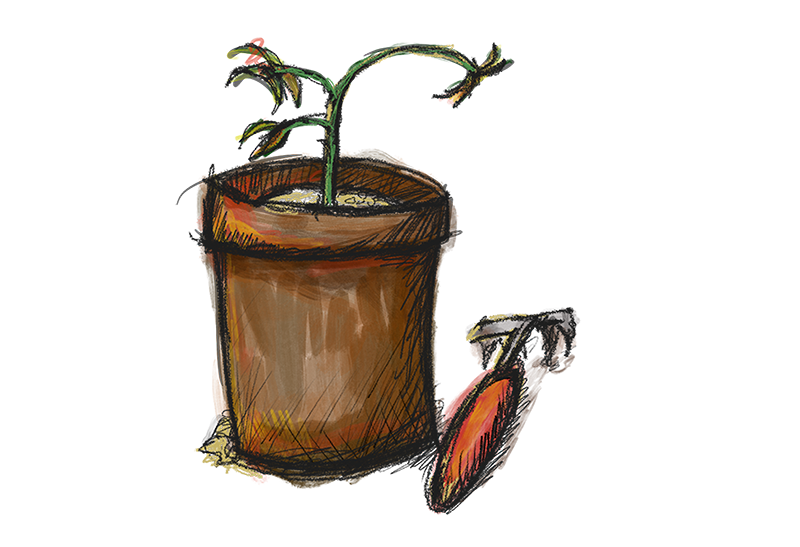
edit ✏️The phrase “digital garden” is a metaphor for thinking about writing and creating that focuses less on the resulting “showpiece” and more on the process, care, and craft it takes to get there.
While not everybody has or works in a dirt garden, we all share a familiarity with the idea of what a garden is.
A garden is usually a place where things grow.
Gardens can be very personal and full of whimsy or a garden can be a source of food and substance.
We gather and work together in community gardens to share the labor as well as the rewards of a collective effort.
It’s a comparison that you can take very far. From “planting seeds” and “pulling weeds” to tending mutiple gardens that each serve an individual need or desired outcome.
Like with real gardens, our digital gardens are a constant ebb and flow towards entropy.
Weeds take over. Left untended the Earth will reclaim what belongs to it.
The same is true for our digital gardens here on the internet.
Organizing information is hard.
I’m not a taxonomist.
I don’t have a formal information design background.
For the most part I just wing it ad hoc and hope for the best. 😅
We are all constantly bombarded with information, a lot of it is really good information too, but the challenge is absorbing it and applying it to the context of our lives and careers.
When I transformed this website to use Gatsby after years of using Jekyll it was like tilling a field and starting fresh. It presented the perfect time to make some changes.
For as long as I’ve been writing words on the internet, I’ve connected the words that I create in a paginated chronological format. This is the “traditional” blog style website. A linear newest-first sorted chronologically oriented list of posts.
I’m convinced that paginated posted sorted chronologically fuckin’ sucks.
What makes a garden is interesting. It’s personal. Things are organized and orderly, but with a touch of chaos around the edges.
Just like plants in the garden I’ve got posts that are in various stages of growth and nurturing. Some might wither and die, and others (like this one you are reading) will flourish and provide a source of continued for the gardener and folks in community that visit 👋
Chronologically sorted pages of posts aren’t how people actually use the internet.
For the most part we use search via Google to find stuff, which is free form and task oriented. You want something, you know what you want, you can string a few words together and hope to get lucky.
As content creators we participate in this process with search engine optimization (SEO) while warehouse full of robot spiders crawl through our posts devouring titles, metadata, and text to help you find what you want.
Another layer of discovery is curation.
If you visit the root of this site you’ll notice that you are welcomed with a small “best of” selection and a few other topics that I wanted to surface for you because they are interesting to me and I’d like to share them with you.
Curation comes before a chronological list. The chronological list is still there, but when you click “all articles” instead of numbered pages, all of the articles on that page are visible. If I had thousands of posts that might be a problem, but with my fairly small catalog the pages loads fast and you can scroll through it easily.
I’ve also got site search which is a nice touch, and something I use often to find posts. It works very well for me because when I am searching my own site, I usually know what I’m looking for.
My personal digital garden extends well beyond this domain. Twitter, Notion, Roam, Slack, Discord, and even Apple Notes all represent digital plots where I tend and water ideas. It’s relaxing to sit down to the keyboard and do a little gardening ❤️
If you’d like to hear more about some of the technical aspects of digital garden tooling with Myself, Chris Biscardi, John Otander, and Kurt Kemple we had a panel discussion about it that you can watch here.
Further Reading
There are two articles that really got me thinking about this.
The first is from Amy Hoy. How the Blog Broke the Web, which is a direct discussion of this idea of sorting posts by dates and how it effectively ruined the best parts of the internet. We’ve moved away from hand crafted home pages that required us to curate and present our best content in the best light.
The second article is from Tom Critchlow titled Building a Digital Garden. What I really like about Tom’s piece is his discussion of the idea of “non-performative blogging” in your personal space on the web.
I love this idea. Instead of “content marketing” we can use our websites to get back to what made the web awesome while also creating better resources for ourselves and our users.
Right now I’m very inspired by both of these pieces, and I’m considering how it affects the way I approach my little slice of the web at https://joelhooks.com. It is a blog, sure, but it is also a wiki. It’s a spot where I can post ideas, snippets, resources, thoughts, collections, and other bits and pieces that I find interesting and useful. Instead of always being a “performance” level of blogging, it can be a looser more human endeavor that drops the idea of robots sorting the content (in this case simply by date created) and embraces the idea of curation, by me, for you.
It’s very exciting, and I look forward to exploring this idea more.
First up for me is adding my reading notes to the site. One of my favorite books of all time is Badass: Making users Awesome by Kathy Sierra. It’s been one of the major influencers for me in terms of how we run egghead.io, and is one of the best books on education that I’ve ever read. When it was published, I read through it, but now I am going back and re-reading it with a highlighter in hand for a deeper understanding.
Check it out, and let me know what you think.
You may also enjoy this article on how I stopped giving af and started writing more.